

Blanca de Tudela is the most widely grown artichoke in Spain, and Violet de Provence is the reference among purple artichokes. Alongside them are seed-grown varieties such as Imperial Star, Harmony, Opal, Madrigal and Concerto, usually grouped as early, medium or late. The exact timing changes with the area and the year.
Updated November 2, 2026
Have you ever thought about how many types of artichokes we can find on the market? At #BlogCynara we know that an #artichokelover always wants to learn more and more. For this reason, we will tell you which varieties are the best known and most widely grown according to the time of year. Treat this grouping as a guide: harvest time changes with the area and the season. Let’s start!
Early artichoke varieties
In this category, there are 4 types of artichokes that we can enjoy in autumn:
Tudela White artichoke
This is the most widely grown variety in Spain. Those from Tudela (Navarre) have Protected Geographical Indication (PGI) status, and those from Benicarló (Castellón) have Protected Designation of Origin (PDO) status.
An #artichokelover trick! To identify this type of artichoke, look at its green color, its rounded, slightly elliptical shape and the circular hole left by the bracts at the top.
It is also a spineless variety.
Violet de Provence
This is the reference variety for purple artichokes in Spain. It is grown mainly in southern Alicante and in Murcia.
Recognizing this very special artichoke is easy, thanks to its violet-tinted bracts.
Much of the crop goes to the French market, so it is not always easy to find in Spain. So now you want to try it, right?
Imperial Star
This artichoke variety, whose name makes us think of Hollywood, is grown from seed and is the most important open-pollinated variety worldwide. It has spherical or subspherical heads and an early harvest.
Lorca
A seed-grown variety with green heads, closely linked to Imperial Star: according to the Cajamar research centre, Imperial Star is also sold as A-106 or Lorca. In its trials it gave some of the smallest heads among seed-grown varieties.
Medium cycle varieties
These varieties are usually harvested in winter and spring.
Green Globe
One of the first artichoke varieties grown from seed, open-pollinated. It is grown in temperate climates.
Its heads are spherical or subspherical.
Harmony
A seed-grown hybrid formerly known as Nun-3031. In a trial in southern Valencia it was among the earliest to harvest, along with Blanca de Tudela and Imperial Star, a good example of how much the cycle depends on place and year.
Late artichoke varieties
These are the last to start harvesting, well into winter, and they carry on into spring.
We can find four types whose names do not go unnoticed either:
Opal
A seed-grown hybrid with purple heads, from Nunhems. In a Cajamar trial it stood out among purple varieties for earliness and good yield, so it is not always that late.
Madrigal
A seed-grown green hybrid from Nunhems. In the Cajamar trial it gave the highest marketable yield, with a very late harvest.
Concerto
A seed-grown purple hybrid from Nunhems, productive and late.
Romanesque
An Italian type of artichoke with its own protected indication, Carciofo Romanesco del Lazio PGI: spherical, compact heads at least 10 cm across, with a characteristic hole at the top. Some varieties are harvested from January and others in March and April.
It takes center stage in Roman cooking, as the main ingredient of Roman-style artichokes. We were already thinking of visiting France to try the purple artichoke, and now we also have to visit Italy.
As you can see, there are wide varieties of artichokes with different characteristics and from other parts of the world. So it makes us consider traveling in search of the best, right?
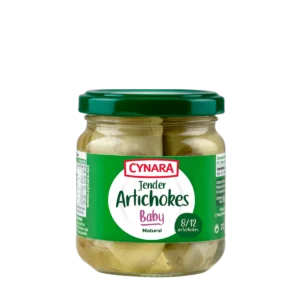
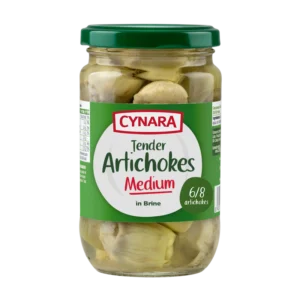
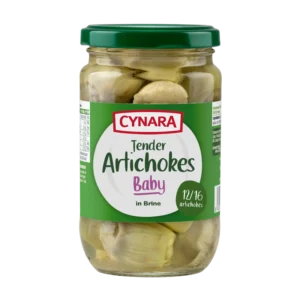
Prefer to stay home? At Cynara we work only with artichokes, in a range of counts and formats.
Did you already know any of these varieties of artichokes? So you really are a #artichokelover.
With Cynara products
Sources
- Reglamento de Ejecución (UE) 2023/1589 y pliego de la IGP Alcachofa de Tudela (INTIA) (2026-11-02)
- Distribución y Consumo (Mercasa), 2005: alcachofa (2026-11-02)
- Baixauli C. Alcachofa: métodos de multiplicación y variedades de semilla. Interempresas, 2019 (2026-11-02)
- Baixauli C et al. Respuesta productiva y agronómica de diferentes cvs de alcachofa multiplicados por semilla (Cajamar) (2026-11-02)
- Ensayo de cultivares de semilla en el sur de Valencia (RiuNet, UPV) (2026-11-02)
- Consumer: ¿Cuántos tipos de alcachofas existen? (2026-11-02)
- ARSIAL: Carciofo Romanesco del Lazio IGP (2026-11-02)